World of Warcraft: Curse of Ula’tek, “Troll Patches Never Miss”
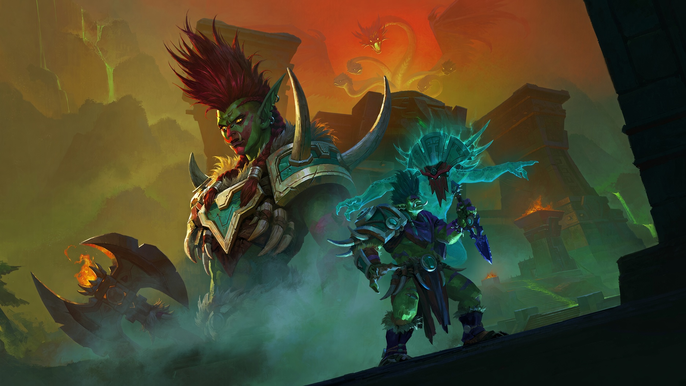
World of Warcraft: Curse of Ula’tek, “Troll Patches Never Miss”
- RELEASED ON:
Midnight opened with, what I consider to be, one of the greatest starts to an expansion I’ve ever experienced. As someone who’s been playing this game since 2008 and has experienced every launch since Wrath of the Lich King, that’s a big statement, but there are few expansions where I’ve felt as though almost every aspect of the game has improved as noticeably.
Just as an example, Blizzard have always reigned supreme in the art of sound design. As a player, I’m so spoilt on perfect audio interactions that I find myself often overlooking the various little sound effects and configurations masterfully sprinkled throughout the game’s world. That’s why I was so thoroughly captivated by the sound design of the Loa shrines in one of the new zones, Zul’Aman. Each shrine serves as a major checkpoint in the zone’s story, as you follow the fierce yet inexperienced leader of the Amani, Zul’jarra, as she seeks the approval of these Loa her brother Zul’jan doesn’t trust. Blizzard seems to have understood the reverence from both the players and the Trolls for these deities, as each shrine is accompanied by totally unique soundtrack and immersive sound effects resembling each Loa.
In case you aren’t caught up on Warcraft lore, Loa are deities (mostly of nature, hence their often-animalistic forms) worshipped by the Trolls, with tribes usually differing by who they worship. Within the fandom, they’re probably the most beloved aspect of Troll lore, spawning several community favourite characters over the years, whether it be Bwonsamdi the Loa of Death from Battle for Azeroth, Hakkar the Soulflayer from Vanilla (Classic), or perhaps even Ula’tek, the main antagonist of World of Warcraft’s latest content update, Patch 12.1, “The Curse of Ula’tek”.
Though Ula’tek isn’t new, she’s actually been in the lore since the Warcraft RPG, but since that lore is two decades old, many of the stories have since been decanonised. Many feared that Ula’tek would never be added after the Isle of Fangs, the location of Ula’tek in the Warcraft RPG, was added to Zandalar in Battle for Azeroth. Those fears were mostly rectified back during the beta when players used far-sight and similar abilities to peer beyond the inaccessible fog around the shores of Zul’Aman and discovered a massive semi-realised island named the “Isle of Fangs”. Well, that island, which was blatantly foreshadowed to be the centre of a future content update during the epilogue of Zul’Aman’s storyline, is in fact our first new major zone, “The Coiled Isle”. Zul’jan stared ominously across the broken bridge towards that island following his nationalist speech, it was only a matter of time.
The storyline of this patch begins with a controversial prologue in one of the previous zones Harandar. The inhabitants of this zone, the Haranir, have realised their ancestral connection to both the Trolls and the Elves. Ironically, though they despise each other, they all share common ancestors. Many players hated this revelation, but not because of how Trolls and Elves relate, but because of how the Haranir are inserted into this long-accepted story. There’s a lot of story nuance lost in the general playerbase, a lot of them took it as the Trolls and Elves descending from the Haranir, especially since the visuals of the cutscene were a little misleading. Additionally, a lot of players are frustrated with the modern game’s obsession with friendship and unity – these players took these scenes as Blizzard trying to unite the Trolls and Elves.
Ironically, the purpose of this chapter was to divide the Trolls and Elves as tensions were beginning to calm. The cutscene ends with Zul’jan furiously objecting to the notion of his people being related to their colonisers. Even when you speak to the various important Troll and Elf NPCs scattered around the room after the cutscene, most of them object or don’t care. Orwyena, a boring Haranir who I don’t have time for, tries to calm Zul’jan by proving their relation through an ancestral vision, one of the Amani’s greatest victory.